- Nalitect Studio
- Posts
- Architecture that affects our thoughts, Mood and behavior
Architecture that affects our thoughts, Mood and behavior
How buildings affect our moods and minds

Namara Allan
December 18, 2023
Did you know that hospital patients in darker rooms use more pain killers?
They report more stress, and have higher mortality rates than patients in brighter rooms?
Or that schools with poor space layouts can stunt a child's cognitive development by 25 percent?
Or that sitting in stressful rush hour traffic can increase rates of night-time domestic violence by up to 9 percent?
Every day, our surroundings affect aspects of our moods, personality, and health.
In today's edition, we're going to dive deeper into the topic of how architecture influences our behavior and mood, based on the book, “How Architecture Affects Our Thoughts, Mood, and Behavior by Danish Kurani”, a leading expert in architectural psychology.
Welcome to Nalitect Studio newsletter where we apply architectural wisdom to improve our lives and well-being.
Architecture is not just the backdrop to our lives, but an active participant shaping who we become. In the pursuit of happiness, health, creativity, identity, and spirituality. We discover:
How natural light, colors, sounds, smells, and plants can enhance our mood and well-being
How spaces can motivate us to exercise, eat, or shop
How spaces can shape our habits and routines
How spaces can influence our moral and ethical choices
How spaces can foster divergent and convergent thinking
How spaces can enhance our memory and attention
How spaces can facilitate collaboration and problem-solving
How spaces can reflect our history and heritage
How spaces can communicate our personality and style
How spaces can convey our meaning and purpose
How spaces can bring us closer to nature and its benefits
How spaces can inspire awe and wonder
How spaces can support our spiritual and religious practice
But how does architecture actually work on our minds and bodies? What are the psychological mechanisms that explain how our surroundings influence our behavior and mood?
Let’s explore some of the theories and evidence that Kurani uses in his book to answer these questions.
The theory of Affordances:
Developed by psychologist James Gibson in the 1970s, Affordances are the possibilities for action that an environment offers to an organism.
For example, a chair affords sitting, a door affords opening, a staircase affords climbing, and so on.
Affordances are not just physical properties of objects, but also perceptual and cognitive ones.
They depend on the abilities and goals of the organism, as well as the context and culture.
For example, a chair can also afford standing, throwing, or burning, depending on the situation and the intention of the actor.
Affordances are important because they shape our behavior and mood by inviting, suggesting, or discouraging certain actions.
For example, a space that affords exercise, such as a gym, a park, or a bike lane, can motivate us to be more physically active and healthy.
A space that affords social interaction, such as a café, a plaza, or a library, can encourage us to be more friendly and cooperative.
A space that affords learning, such as a classroom, a museum, or a lab, can stimulate our curiosity and creativity.

Local Material choices for a naturally breathing space, and tall vented window openings for natural light and ventillation afford learning and creativity.
However, not all affordances are positive or beneficial.
Some affordances can have negative or harmful effects on our behavior and mood.
For example, a space that affords violence, such as a dark alley, a prison, or a war zone, can trigger fear, aggression, or trauma.
A space that affords isolation, such as a cubicle, a cell, or a bunker, can induce loneliness, depression, or anxiety.
A space that affords distraction, such as a mall, a casino, or a highway, can reduce our focus, attention, or productivity.
Therefore, it is crucial to design spaces that offer the right affordances for the right purposes and people.
It makes sense therefore to consider the following questions when designing or evaluating a space:
What are the goals and needs of the users of the space?
What are the affordances that the space offers to the users?
Are the affordances aligned with the goals and needs of the users?
How can the affordances be enhanced, reduced, or changed to better suit the users?
By asking and answering these questions, we can create spaces that influence our behavior and mood in positive and meaningful ways.
The theory of environmental stress:
Second is the theory of environmental stress, developed by psychologist Robert Gifford in the 1980s.
Environmental stress is the negative psychological and physiological response that occurs when there is a mismatch between the demands of the environment and the resources or coping abilities of the individual.
For example, environmental stress can occur when the environment is too noisy, crowded, polluted, chaotic, or unpredictable.
Environmental stress can have various effects on our behavior and mood, such as:
Reducing our performance, efficiency, and quality of work
Increasing our errors, accidents, and Injuries
Impairing our memory, attention, and learning
Lowering our satisfaction, happiness, and well-being
Raising our frustration, anger, and aggression
Weakening our immune system, health, and longevity
Therefore, it is important to design spaces that reduce or prevent environmental stress by creating a balance between the demands of the environment and the resources or coping abilities of the individual.
Consider the following factors when designing or evaluating a space:
The physical factors, such as the temperature, lighting, ventilation, noise, and cleanliness of the space
The social factors, such as the density, diversity, and interaction of the people in the space
The personal factors, such as the personality, preferences, and expectations of the individual in the space
The situational factors, such as the duration, frequency, and purpose of the exposure to the space

Less Environmental stress in a cozy, clean and vibrant space with an array of artificial lights
By considering these factors, we can create spaces that influence our behavior and mood in positive and healthy ways.
Application of the theories:
Let's take a look at a real-life example of how architecture can influence our behavior and mood.
This is the story of the Opera Village, a cultural and social project in Burkina Faso, initiated by the late German filmmaker Christoph Schlingensief and designed by Diébédo Francis Kéré , the first African to win the prestigious Pritzker Prize, often referred to as the Nobel Prize of architecture.
The Opera Village is a complex of buildings that includes a school, a health center, a library, a theater, a cinema, a sports field, and a guest house.
The project aims to provide education, health, culture, and empowerment to the local community, as well as to foster dialogue and exchange between Africa and the rest of the world.
The Opera Village is a great example of how architecture can influence our behavior and mood, and how it can apply the theories of affordances and environmental stress.
The buildings offer various affordances that support the goals and needs of the users, such as:
The school affords learning, creativity, and collaboration, by providing spacious and bright classrooms, writable walls, movable furniture, and interactive technology
The health center affords healing, comfort, and privacy, by providing natural light, ventilation, colors, plants, and curtains
The library affords reading, writing, and research, by providing books, computers, desks, and chairs
The theater affords performing, watching, and celebrating, by providing a stage, a screen, a sound system, and seats
The cinema affords entertainment, education, and inspiration, by providing films, documentaries, and workshops
The sports field affords exercise, play, and competition, by providing a soccer pitch, a basketball court, and a volleyball net
The guest house affords hospitality, relaxation, and exchange, by providing rooms, beds, bathrooms, and a kitchen
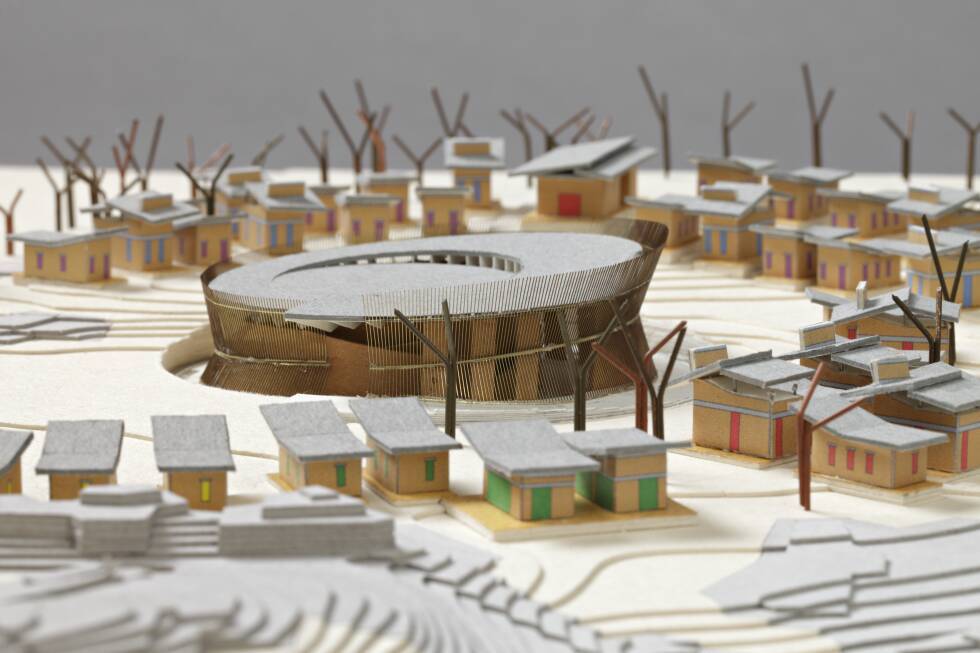
The Opera Village project still under construction
The buildings also reduce or prevent environmental stress by creating a balance between the demands of the environment and the resources or coping abilities of the users, such as:
The buildings use local materials, such as clay, wood, and metal that are durable, sustainable, and affordable
Passive design strategies, such as orientation, shading, and insulation that regulate the temperature, lighting, and ventilation of the space
Modular and flexible design solutions, such as vaults, domes, and arches, that adapt to the terrain, the climate, and the needs of the space
Colorful and playful design elements, such as patterns, shapes, and textures, that add visual interest, identity, and meaning to the space
The buildings use participatory and collaborative design methods, such as workshops, surveys, and feedback that involve the local community, the users, and the stakeholders in the design process
The Opera Village is a great example of how architecture can influence our behavior and mood, and how it can help us achieve our goals and potential.
It shows that architecture is not just a pretty backdrop to our lives, but an active participant shaping who we become.
If you want to learn more about how we can apply architectural wisdom to influence behaviors, mood and productivity in our lives and society;
Be sure to subscribe to the Newsletter, Have a lovely week of a boosted mood and mind; Cheers!
-Namara Allan